
Working in Oils: Slowing Down, Letting It Evolve
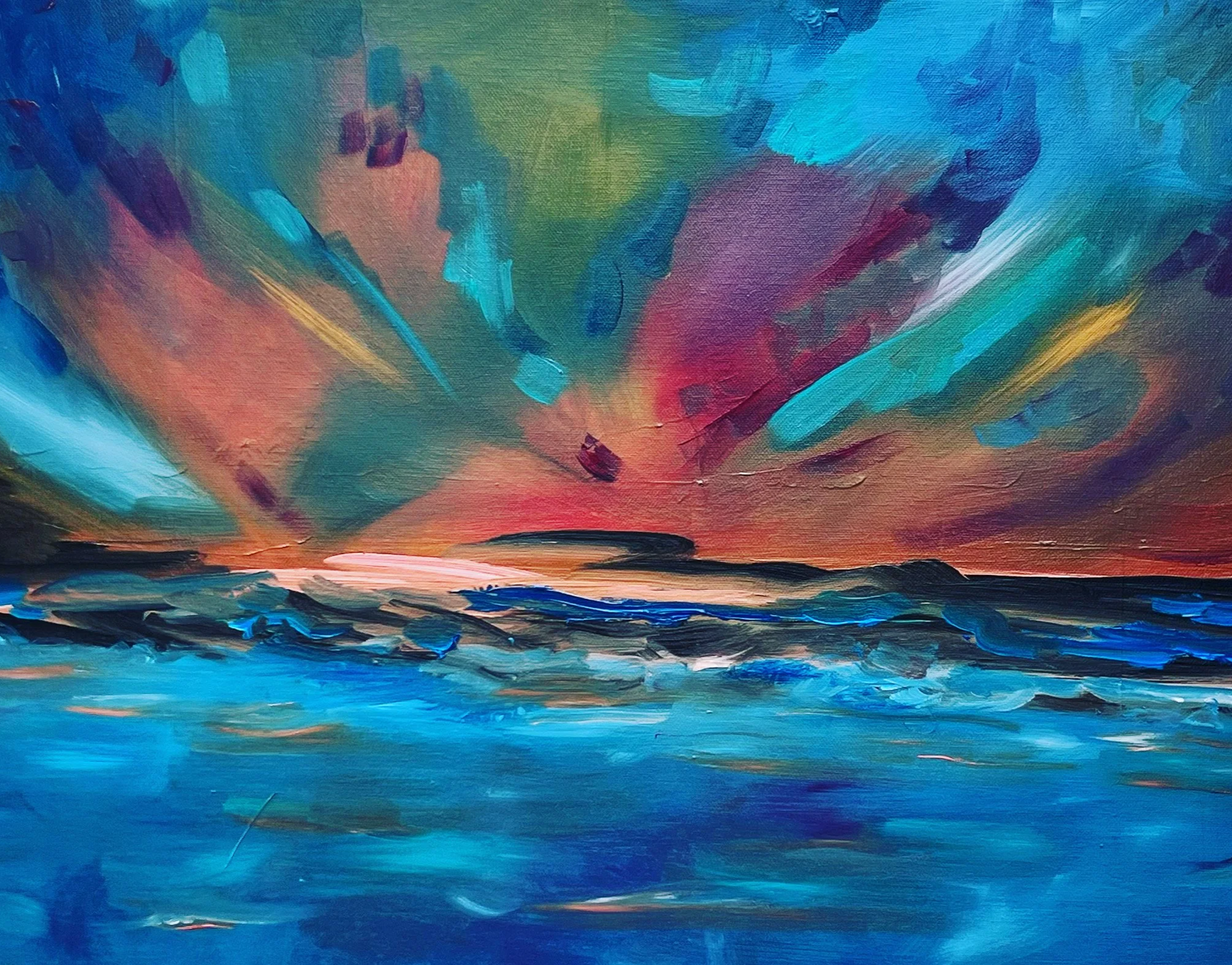
Radiance Beyond the Horizon 2022
Oil on Canvas by Olivia Reppas
"An exploration of colour and emotion, where sea and sky meet in a moment of luminous transformation."
Medium: Oil on Canvas
Artist: Olivia Reppas
Style: Contemporary Abstract Landscape
Themes: Light, Water, Movement, Atmosphere, Reflection
Why Oils Feel Different
There’s something about oil paint that asks you to slow down.
It doesn’t rush you. It doesn’t dry before you’ve made up your mind. It sits there—open, workable—waiting for you to respond. And in that space, something different happens. The painting becomes less about control, and more about conversation.
Oil paint holds colour in a way that feels deep and alive. It doesn’t flatten out. It shifts with the light. Colours blend softly into each other, edges blur, and transitions happen almost without effort.
You’re not just placing colour—you’re moving it.
That’s what makes oils so powerful, especially if you’re drawn to expressive or intuitive work. You can push paint around, scrape it back, layer over it, and come back hours—or even days—later and keep working.
Letting Go of Speed
If you’re used to acrylics, oils can feel unfamiliar at first.
They don’t reward speed in the same way. Instead, they invite you to:
Pause
Look longer
Adjust slowly
And that’s where the magic is.
Because when you’re not rushing, you start to notice more. Subtle colour shifts. Small movements. The way one tone changes everything around it.
Building Layers, Not Perfection
One of the biggest shifts when working in oils is learning that the first layer doesn’t matter as much as you think.
You can:
Paint over it
Wipe it back
Rework entire sections
Nothing is final too early.
That freedom changes the way you paint. You stop trying to get it “right” straight away, and instead allow the piece to evolve.
Colour That Moves
Oils are incredibly forgiving when it comes to colour.
If something feels too harsh, you can soften it.
Too flat? Add depth.
Too heavy? Lift it back.
Blending becomes intuitive. Colours can melt into each other, creating richness that’s hard to achieve in faster-drying mediums.
This is where oils really shine—especially in work that’s driven by feeling rather than strict structure.
A More Intuitive Process
For me, working in oils is less about planning and more about responding.
I’ll start with a loose idea—a colour palette, a feeling, maybe a memory of light or landscape—and then let the painting unfold. Oils allow that kind of approach. They give you time to change direction without losing the work.
It becomes a process of:
Listening
Adjusting
Letting the piece find itself
The Beauty of Time
There’s patience required with oils—but it’s a different kind of patience.
Not waiting for something to happen, but allowing it.
Allowing colours to settle.
Allowing decisions to shift.
Allowing the painting to become something you didn’t expect.
If You’re Thinking of Trying Oils
Start simple.
You don’t need a huge setup. Just:
A few colours
A surface
Time to explore
Let go of the idea that you need to master it straight away. Oils reward curiosity more than precision.
Final Thought
Working in oils feels like stepping out of urgency and into something slower, richer, more considered.
It’s not about finishing quickly.
It’s about staying with the work long enough for it to reveal itself.
And often, that’s where the best pieces come from.
